
The Springfield Gold Deposit is located approximately 10km south of the town of Gulgong in NSW (see Figure 1).
Mineralisation is hosted by a monzodiorite intrusion that outcrops at surface and has been mapped to extend over >1,700m of strike in a north-south direction (see Figure 2).
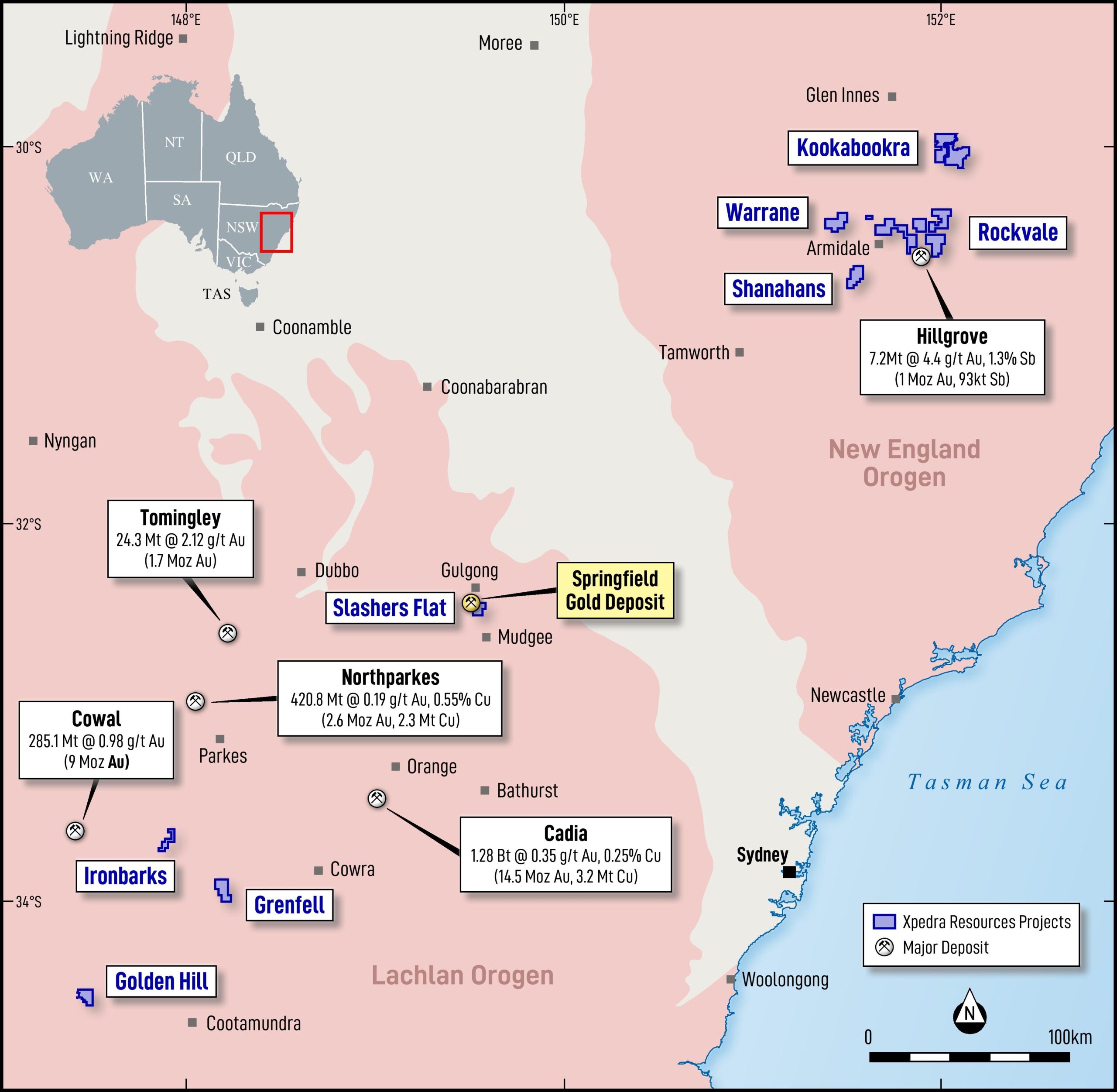
Figure 1. Location of Xpedra’s projects in NSW, including its Springfield Gold Deposit within the Slashers Flat Project and the Rockvale Gold-Antimony Project that surrounds, and is immediately adjacent to, Larvotto Resources’ Hillgrove Gold-Antimony Deposit.
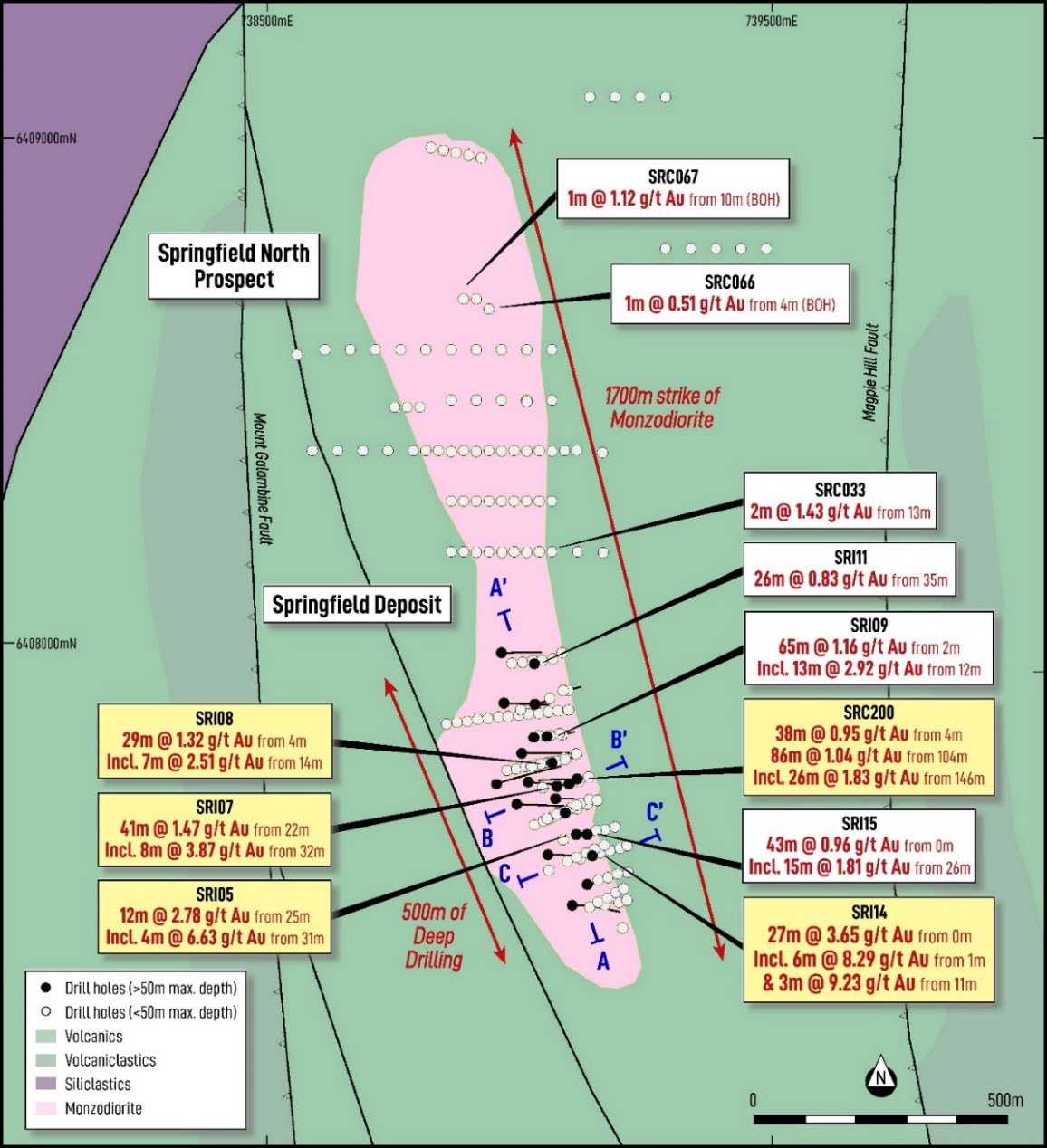
Figure 2. The mineralised monzodiorite at the Springfield Gold Deposit is mapped to extend over >1,700m of strike, with all previous drilling to test for depth extensions of the shallow mineralisation focused on just 500m of strike at the Springfield Deposit. High-grade mineralisation is also evident in shallow drilling at the Springfield North Prospect but is yet to be followed up.
Previous Exploration
Previously, a total of 186 holes were drilled into the Springfield Deposit and the Springfield North Prospect, for a total of 6,568 metres. The average depth of these holes is only 35 metres. The deepest hole was 249.1m long (inclined).
Mineralisation was initially delineated by drilling east-west fences of shallow, vertical holes over the mineralised monzodiorite.
Follow-up drilling, to test below the shallow mineralisation evident in the vertical holes, has been constrained to only 500m of the >1,700m strike of the mineralised intrusion, with significant mineralisation intersected at depth over the entire 500 metres of strike that has been tested to date (see Figure 2).
Considerable thicknesses of high-grade mineralisation have been intersected at very shallow depths, including:
- 27.0m @ 3.65 g/t Au from 0m (surface), including:
- 6.0m @ 8.29 g/t Au from 1.0m; and
- 3.0m @ 9.23 g/t Au from 11.0m (SRI14)
- 65.0m @ 1.16 g/t Au from 2.0m, including:
- 13.0m @ 2.92 g/t Au from 12.0m (SRI09)
- 41.0m @ 1.47 g/t Au from 22.0m, including:
- 8.0m @ 3.87 g/t Au from 32.0m (SRI07)
- 43.0m @ 0.96 g/t Au from 0m (surface), including:
- 15.0m @ 1.81 g/t Au from 26.0m (SRI15)
- 29.0m @ 1.32 g/t Au from 4.0m, including:
- 2.0m @ 4.61 g/t Au from 4.0m; and
- 7.0m @ 2.51 g/t Au from 14.0m (SRI08)
- 23.0m @ 1.49 g/t Au from 0m (surface), including
- 3.0m @ 2.60 g/t Au from 4.0m; and
- 6.0m @ 2.10 g/t Au from 14.0m (SRV66)
- 12.0m @ 2.78 g/t Au from 25.0m, including:
- 4.0m @ 6.63 g/t Au from 31.0m (SRI05)
Significantly, thick intervals of mineralisation were returned from the two deepest holes drilled to date, with assays including:
- 86.0m @ 1.04 g/t Au from 104.0m, including:
- 26.0m @ 1.83 g/t Au from 146.0m (SRC200); and
- 46.8m @ 0.58 g/t Au from 135.25m, including:
- 2.2m @ 2.33 g/t Au from 179.85m (MPS1A)
The mineralisation remains completely open in both directions along strike and at depth (see Figures 3, 6 and 7).
The Springfield Deposit is located in a structural corridor that is bounded by two major north-south trending faults which extend for >7,000 metres within the Company’s project area. This entire corridor is considered to be highly prospective (see Figure 4).
Anomalous arsenic (and gold) results were returned over the entire 1,700m of strike that has been covered, historically, with shallow air-core drilling. The arsenic anomalism is very broad across the strike of this entire corridor (see Figure 5). This is further evidence that the known mineralisation is likely to be part of a large system. This bodes well for the potential to discover more gold mineralisation with further drilling beneath these shallow arsenic anomalies.
Significantly, gold and arsenic anomalism in the shallow air-core drilling is strongest – and completely open – at the southern end of the area covered by this historical air-core drilling (see Figure 5), so there is considerable potential to discover additional mineralisation to the south of the Springfield Deposit (as well as to the north).
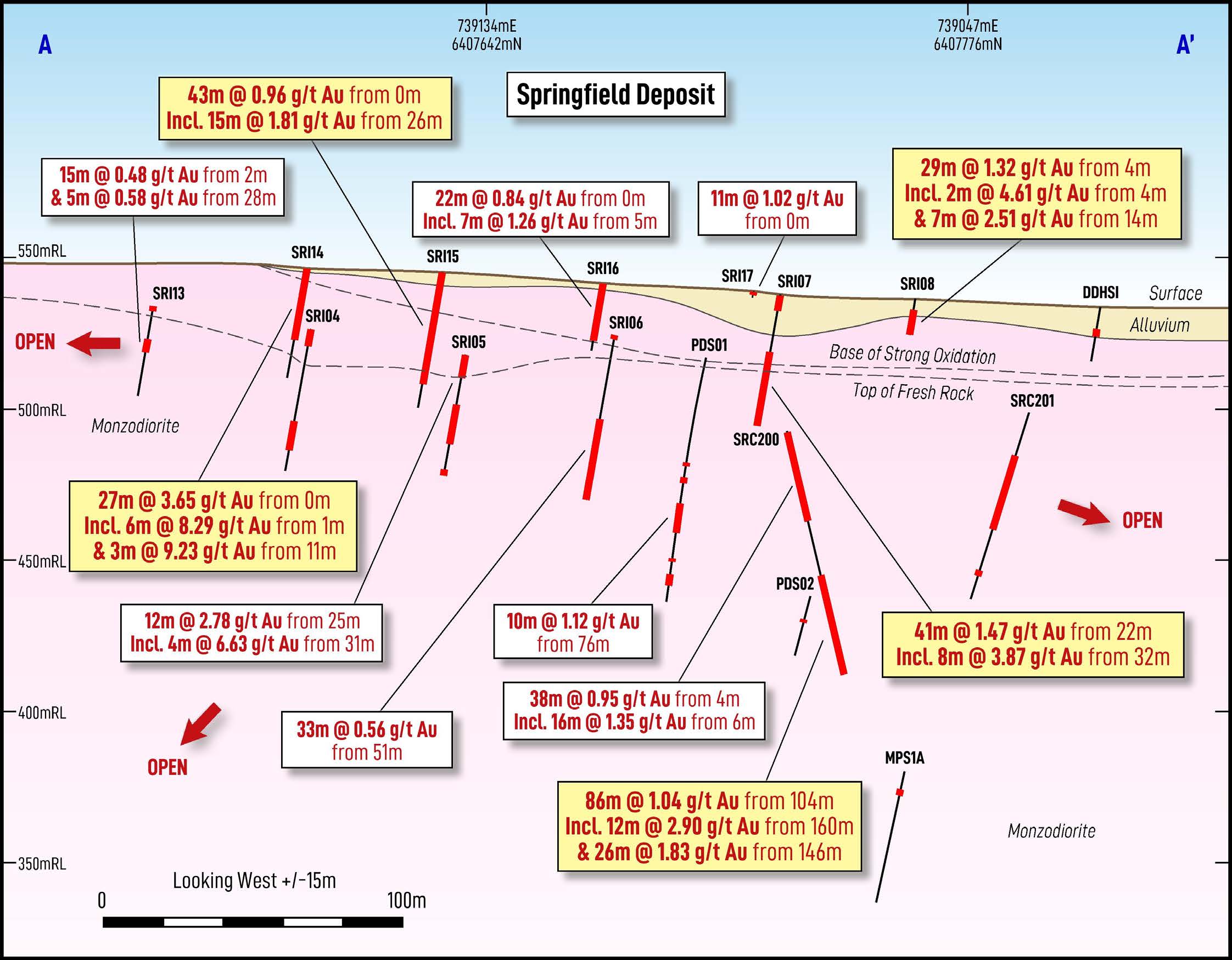
Figure 3. Long section illustrating significant intercepts of mineralisation at the Springfield Gold Deposit to date. Mineralisation remains open in all directions. (See Figure 1 for location of long section; Drillholes for which Xpedra has no assay data are not included in this diagram).
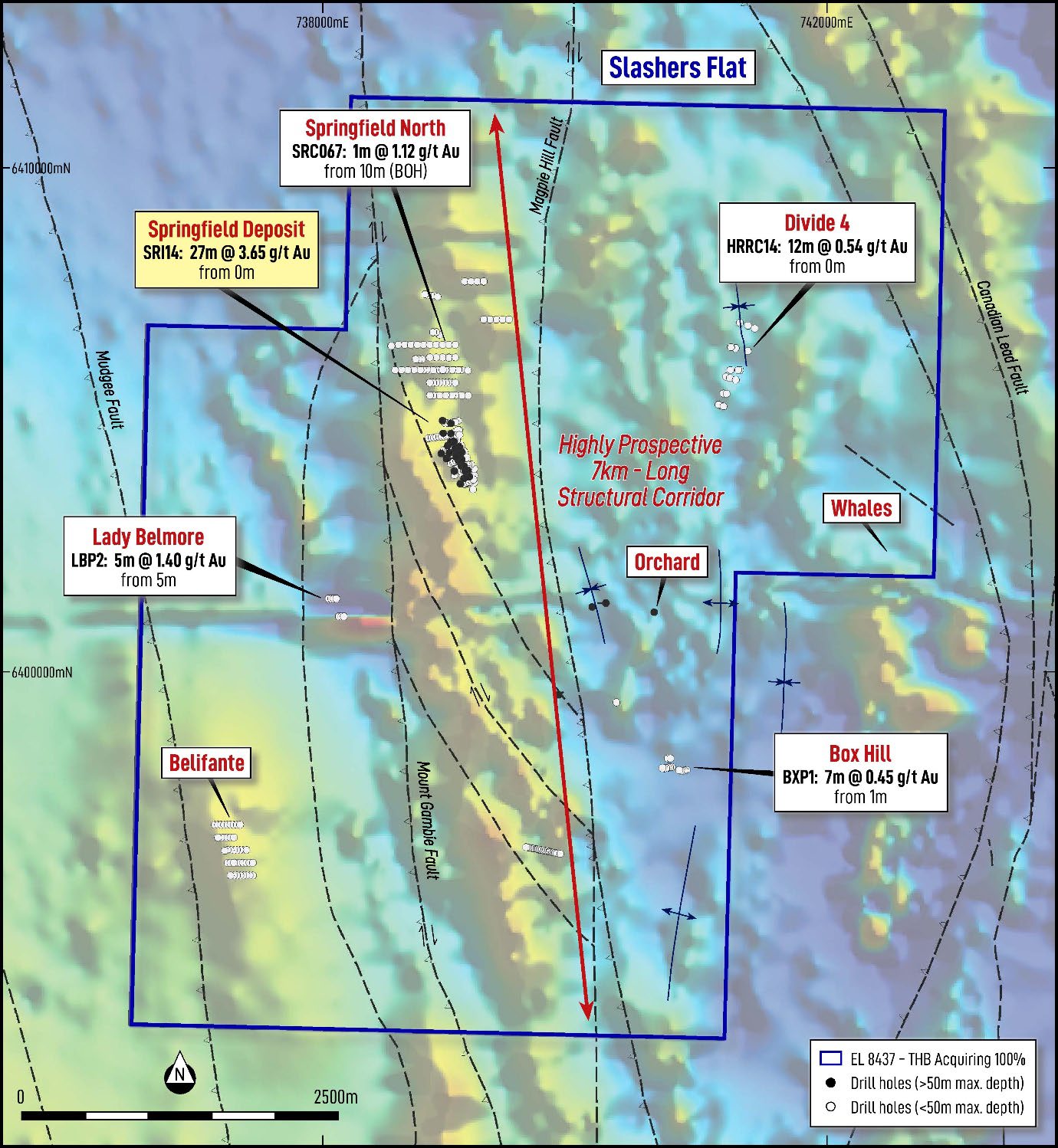
Figure 4. Reduced to pole aeromagnetic data over the Slashers Flat Project, illustrating that the Springfield Gold Deposit is located within a 7km-long north-south trending structural corridor that is bounded by the Mt Galambine and Magpie Hill Faults.
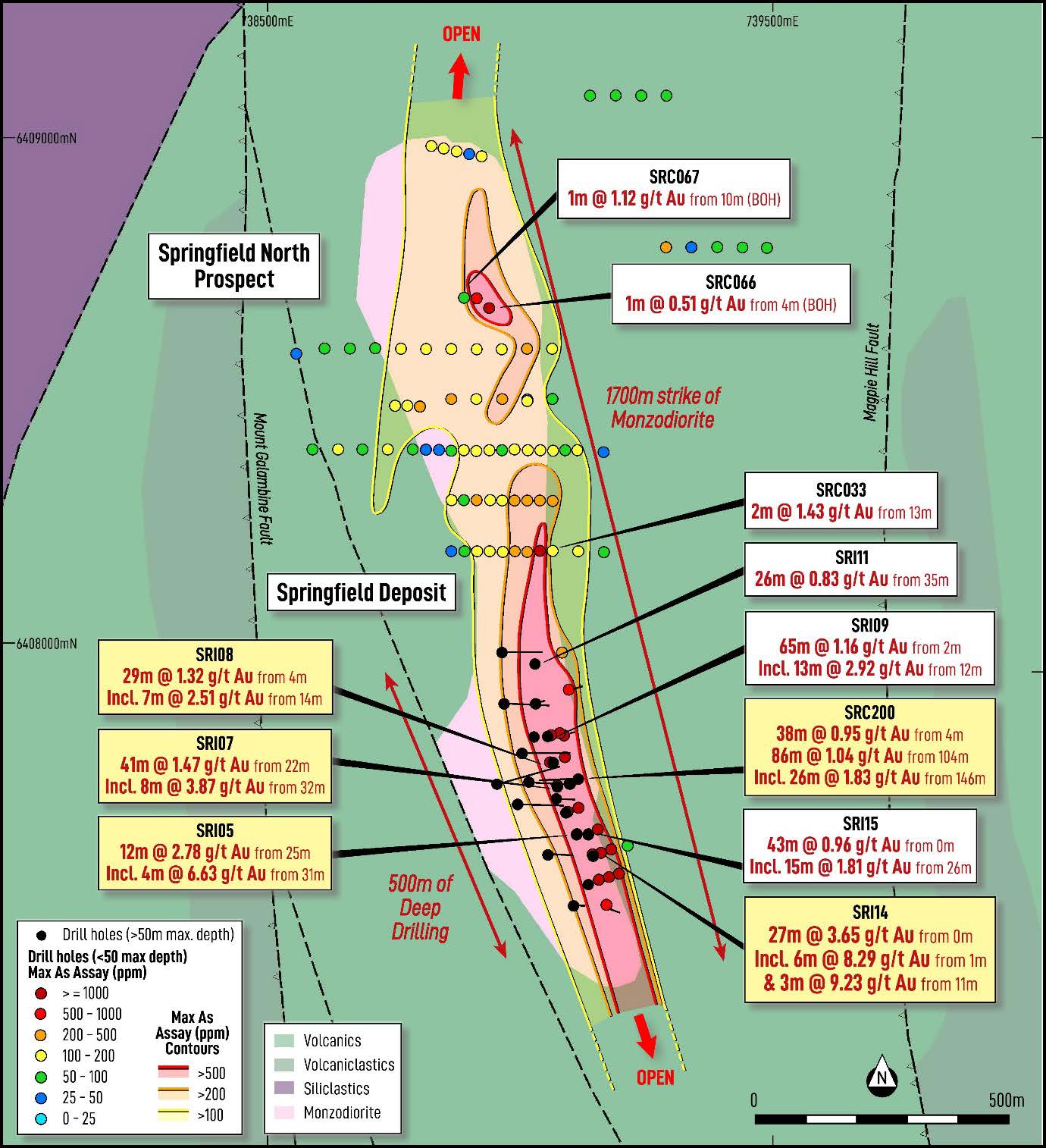
Figure 5. Maximum arsenic assays in historical shallow air-core drilling at the Springfield Gold Deposit and Springfield North Prospect. Recent work has shown that there is a close correlation between arsenic and gold. Accordingly, the strong arsenic anomalism evident over the entire 1,700m strike of the mapped monzodiorite intrusion is considered to be a high-priority target area for further exploration drilling. The arsenic anomalism is notably very strong, and open, at the southern end of the Springfield Deposit, so this is also a high-priority area for further exploration drilling.
Springfield North Prospect
Encouragingly, significant mineralisation has been intersected in previous first-pass shallow, vertical air-core drilling at the Springfield North Prospect, immediately to the north of the Springfield Deposit (see Figures 2 and 5). Significant results have been returned over 500m of strike at Springfield North, including:
- 2m @ 1.43g/t Au from 13.0m (SRC033); and
- 1m @ 1.12 g/t Au from 10m (to EOH; SRC067)
No drilling has been undertaken to follow-up this shallow mineralisation, even though the mineralisation is hosted by the same monzodiorite that hosts the Springfield Deposit.
Access to the Springfield Deposit and the North Springfield Prospect is extremely good, with both areas (and indeed the vast majority of the greater project area) located within open paddocks used for grazing (see photo above).
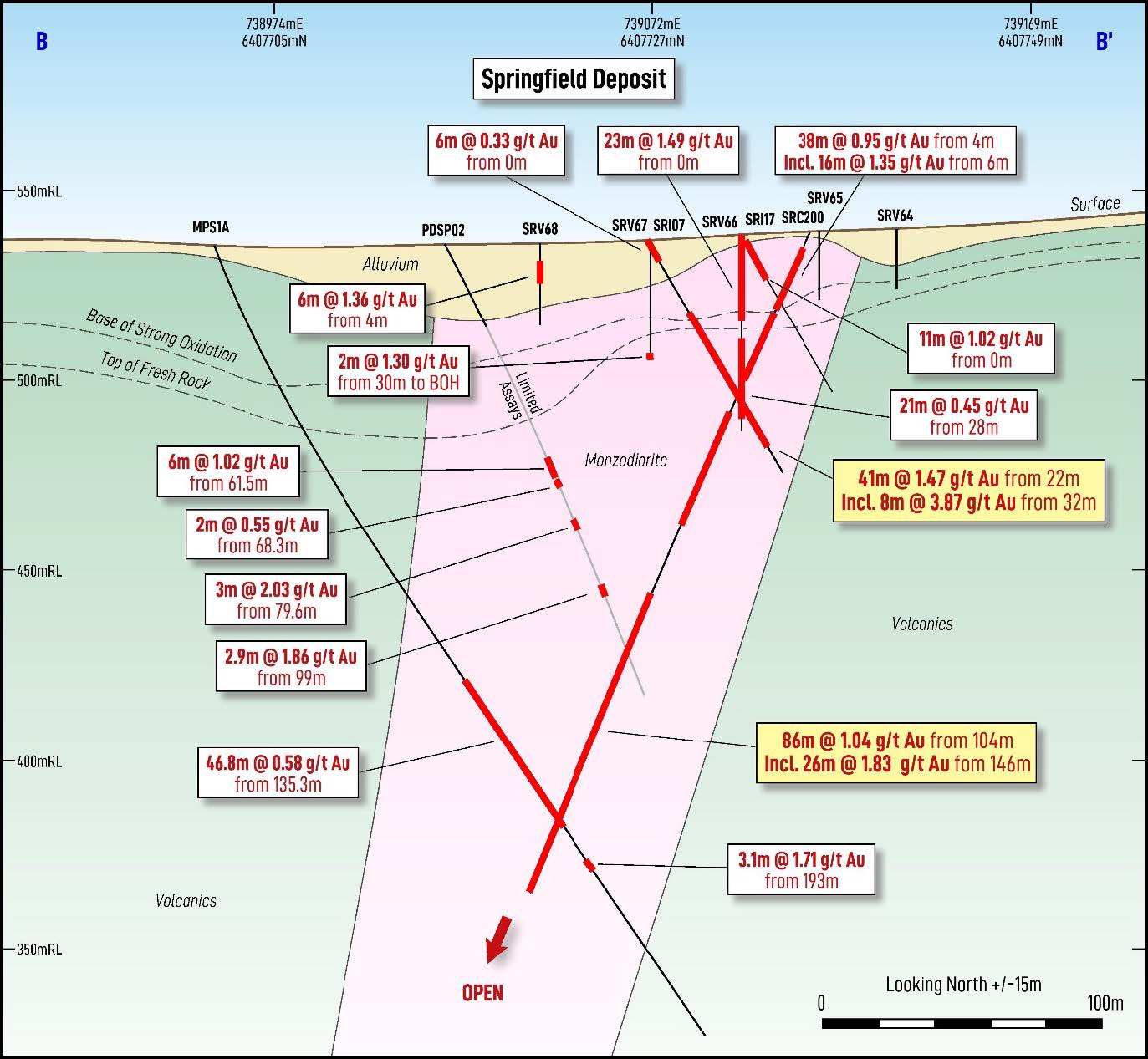
Figure 6. Cross section B-B’ illustrating mineralisation at the Springfield Gold Deposit. Mineralisation remains open in all directions. (See Figure 2 for location of cross section).
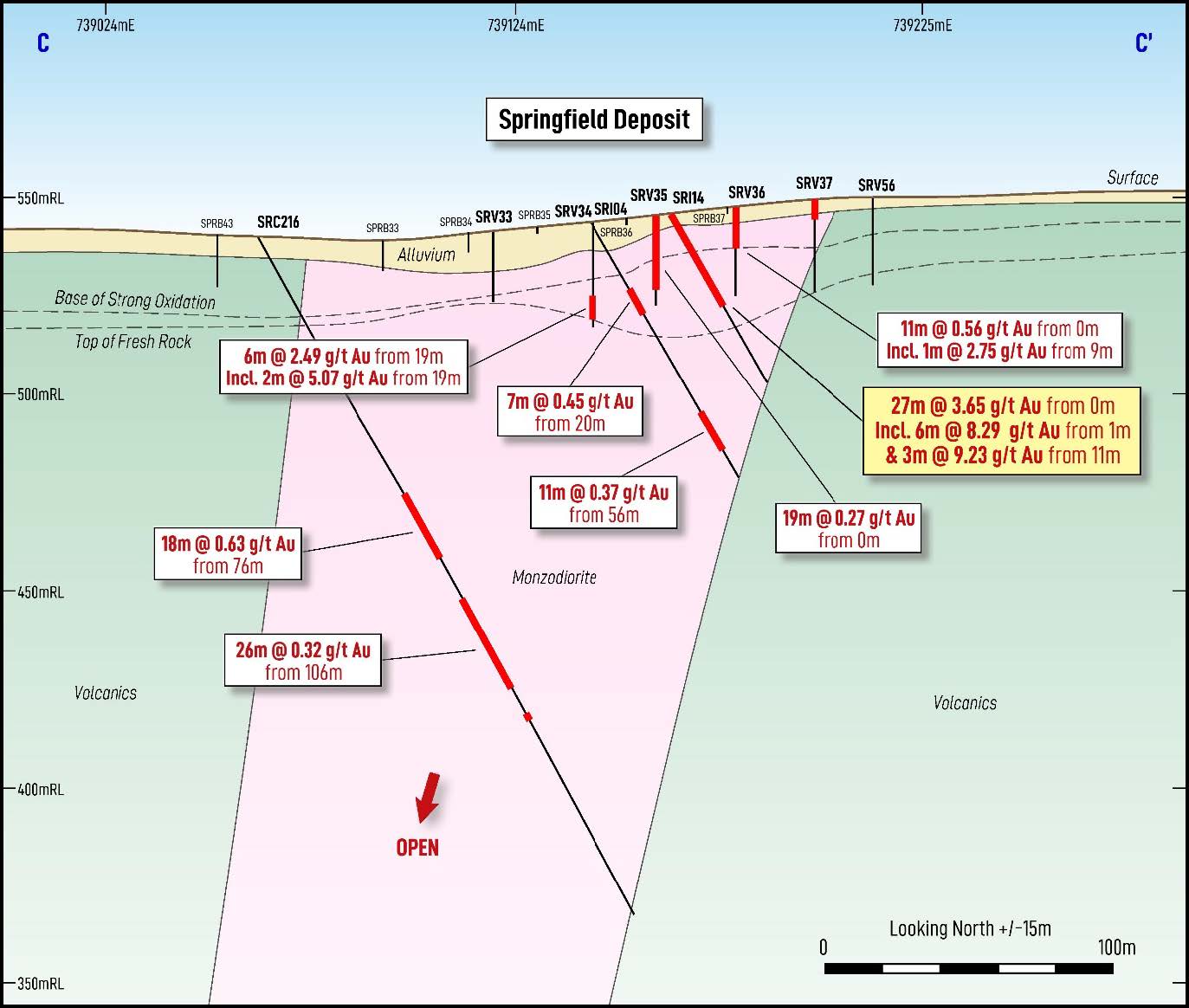
Figure 7. Cross section C-C’ illustrating mineralisation at the Springfield Gold Deposit. Mineralisation remains open in all directions. (See Figure 2 for location of cross section).
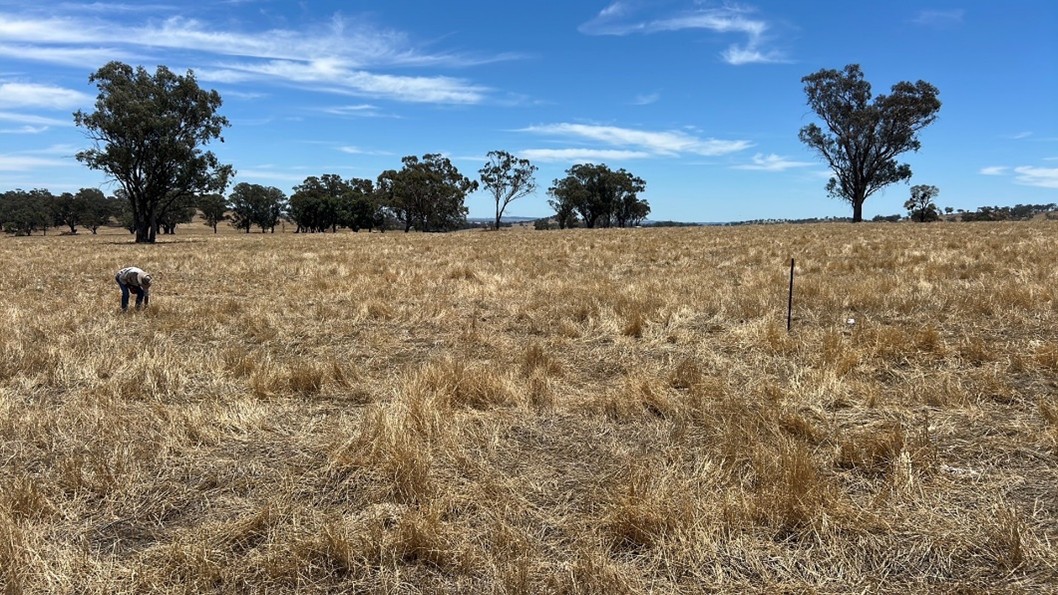
Readily accessible, open grazing land at the Springfield Gold Deposit and Springfield North Prospect.
Other Mineralisation within the Slashers Flat Project
Gold mineralisation is present at multiple other prospects within the Slashers Flat Project area (see Figure 8).
At the Lady Belmore Prospect, seven shallow percussion holes (each 20-30m deep) have been drilled previously to test for mineralisation in quartz veins in felsic volcanics adjacent to an elongated silicic syenite intrusion (a total of 178m of drilling; see Figure 8). Encouraging results included:
- 5m @ 1.40 g/t Au from 5.0m (LBP2); and
- 5m @ 1.09 g/t Au from 20.0m (LBP1)
At the Divide 4 Prospect, 17 shallow holes have been drilled previously to test for mineralisation in an elongated syenite intrusion (a total of 650m of drilling with a maximum depth of 48m; see Figure 8). Extensive alteration was evident, with encouraging results including:
- 1m @ 1.63g/t Au from 21.0m (D4P3); and
- 1m @ 1.35g/t Au from 11.0m (HRRC14)
The Company is currently reviewing all previous exploration data so that targets arising can be ranked, and appropriate plans made to follow up prioritised target areas.
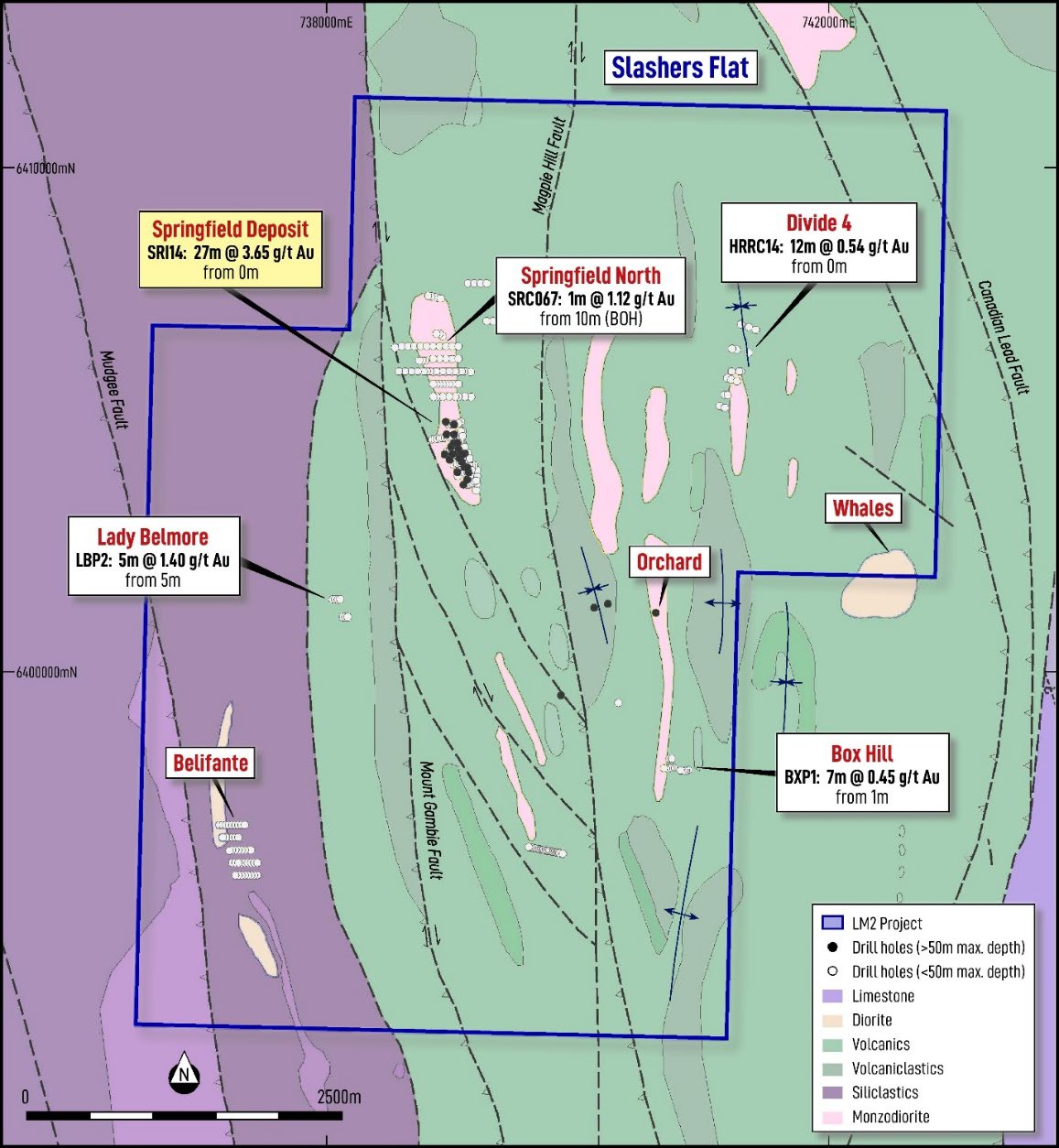
Figure 8. All previous drilling within the Slashers Flat project area. Multiple intrusions have been mapped within the project area, with many of these known to be mineralised (including at Springfield).
Forward Work Plan
No drilling has been undertaken at the Springfield Deposit since 1999.
In early March 2026 the Company mobilised an RC drilling rig to the project to commence the first drilling program in more than 27 years.
This maiden drilling program will comprise 30-40 Reverse-Circulation (RC) drill holes for 3,000-4,000 metres.
Holes will be drilled to:
- Confirm the veracity of historical drilling results at the Springfield Deposit;
- Test for local controls on high-grade mineralisation at the Springfield Deposit;
- Begin to test for extensions of the mineralisation at the Springfield Deposit, which remains completely open:
- Along strike in both directions; and
- At depth; and
- Begin to test for extensions of very shallow gold mineralisation that was intersected at the Springfield North Prospect in historical, first-pass, shallow vertical air-core drilling.